Tree record 秋 · Autumn
Crabapple, shakan: getting fruit to hold past November
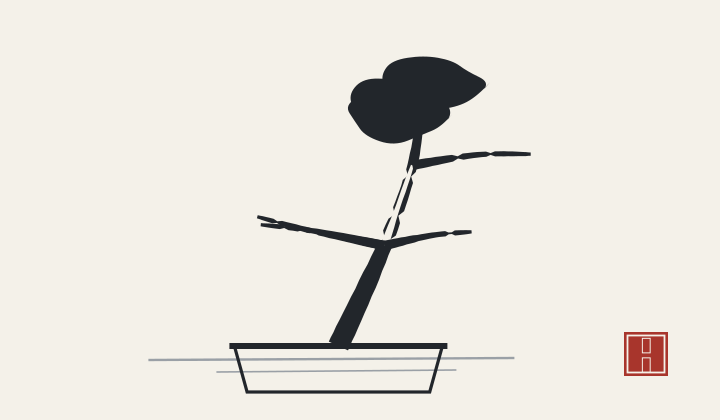
- Style form
- Shakan — slanting, trunk at about 30 degrees off vertical
- Pot
- Unglazed cream rectangle, deeper on the lean side, 28 x 20 x 9 cm
- Wire gauge
- 3.0 mm on the trunk, 2.0 mm on the two main branches
- Wiring window
- February, before bud burst; check every 8 weeks
- Prune window
- After flowering in May; fruit thinned in July
- Repot interval
- Every 3 years, after flowering
- Wintering
- USDA zone 5b; fruit holds better if kept below 8 C but frost-free
- Years in training
- 7
Cultivation record
A flowering crabapple is two trees in one season: blossom in April and fruit from August to the first hard frost. Most of them lose the fruit in September. This record is about the shaping that took seven years and the three things that actually decide whether the fruit stays.
The lean was chosen from the nebari, not the trunk
The tree arrived in 2019 with a 3.5 cm trunk that leaned about 35 degrees and a root spread that was noticeably heavier on the left. Both the lean and the root mass pointed the same way, which is the only condition under which shakan is worth committing to. The planting angle was set at 30 degrees in February 2020 using a 3.0 mm wire anchored into the soil and over the base, held for two seasons until the trunk held the position on its own. The wire was removed in March 2022 after a full inspection showed no marking.
Balancing the crown against the base
A slanting trunk needs visual mass on the side it leans away from, otherwise it reads as unstable. Two branches were kept on the right — the low one long and horizontal, the upper one shorter and angled up — and only one on the left, placed high. The lowest left-hand branch was removed in 2021 to open the space under the lean. Canopy volume ends up roughly 60 percent right, 40 percent left. The apex is deliberately pulled back over the base rather than continuing the line of the trunk, which is what stops the tree looking like it is being blown over.
Blossom management in April
Spurs that carried blossom are cut back to two or three buds immediately after the flowers drop, in the first week of May. Any spur left unpruned fruits in the same place for a second year, and after two consecutive years it is exhausted and stops flowering altogether. This tree flowers on two-year-old wood, so the pruning pattern has to alternate the sides of each branch — one year left, the next year right — to keep blossom spread across the whole canopy instead of clustered at the tips.
Three things that decide whether fruit holds
First, thinning: in the second week of July the cluster is reduced to one fruit per spur and, on branches under 4 mm, to one fruit every third spur. This tree sets roughly 140 fruit and is thinned to about 35. Second, water consistency: irregular watering in August causes more fruit drop than any pest, so the pot is topped up daily and never allowed to swing between bone dry and soaking. Third, feeding: a low-nitrogen, high-potash feed from July to early September at half strength every ten days, and no nitrogen after mid June.
Position and pest control through the fruit season
From August the tree sits where it gets morning sun and afternoon shade, which slows the fruit ripening and stretches the display by several weeks. It is turned a quarter turn every ten days so colour develops evenly. Apple scab shows as dark blotches from July; it is managed by keeping the foliage dry at night, which means watering the soil and never the leaves after midday. Codling moth is trapped with a single pheromone lure hung in the canopy from late May, replaced every eight weeks.
What to remember
- Commit to slanting style only when the nebari and the lean agree.
- Prune flowering spurs to two or three buds right after petal fall.
- Thin to roughly one fruit per spur, and to one in three spurs on thin branches.
- Consistent August watering and no nitrogen after mid June do more for fruit retention than any spray.
Note Growing notes are provided for general information only. Never apply any pesticide or fungicide without reading and following the product label for your region.