Tree record 冬 · Winter
Windswept black pine: training a tree to lean into one wind
- Style form
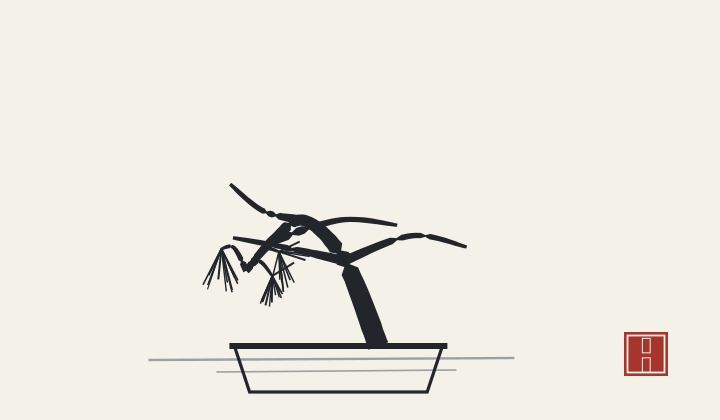
- Fukinagashi — windswept, every branch trained to one side
- Pot
- Shallow unglazed oval, 30 x 22 x 6 cm
- Wire gauge
- 2.5 mm and 3.0 mm on the two windward branches, 1.2 mm on outer twigs
- Wiring window
- November to January; re-check every six weeks in the first year
- Prune window
- Candle cut late June; all growth on the leeward side removed
- Repot interval
- Every 3 years, early March
- Wintering
- USDA zone 6a; the flat pot needs root protection below -10 C
- Years in training
- 9
Cultivation record
Fukinagashi is the least naturalistic style in bonsai, because no tree actually grows like this for long. It works only when the wind direction is completely consistent: one side of the tree has branches, the other side has none at all, and the pot gives the wind away.
Choosing the wind direction and committing to it
The tree leans 22 degrees to the left from the base and the pot rim is 1.5 cm lower on that side, so everything blows left. Once that was fixed in 2018, no branch has ever been allowed to develop on the right. Every bud that appears there is rubbed out while it is still green, which on a black pine means a check roughly every twelve days from April to August. Over nine seasons that habit has produced a hard, clean edge on the leeward side with no stubs at all.
Making the branches flow, not just point
Four branches were kept, all on the left, at 18, 26, 34 and 41 cm above the soil. Each was wired with 2.5 or 3.0 mm aluminium and given a compound curve — first lifting slightly, then falling away — rather than a straight sweep. A branch that points straight downwind looks stiff; a branch that rises a little before it falls reads as foliage being lifted and then dragged, which is how wind actually behaves. The wire stays on a black pine no more than four months, so the bend was made in two sessions a year apart.
Pads with a ragged outer edge
Windswept pads must not be symmetrical. On the outer end of each branch the pads are allowed to grow longer and looser, with the tip foliage extending 6 to 8 cm past the structural end of the branch. On the inner end, close to the trunk, the pads are pinched tight to two buds. That difference — loose outside, tight inside — is what makes the direction of the wind readable even in a photograph with no background.
Watering against the lopsided root mass
Nine years of growth in one direction has produced a root mass that is markedly heavier on the windward side, which is correct for stability but means the pot dries unevenly. Water is applied on the light side first and given twice as long there. At repotting the heavy side is root-pruned more aggressively — up to a third of the fine roots — while the light side is barely touched. The tree is also rotated 90 degrees each winter, not to balance growth but to keep the bark on the windward side from staying damp.
What to remember
- Fix the wind direction once and remove every bud on the wrong side for the life of the tree.
- Give each branch a compound curve: lift slightly, then fall away.
- Keep outer pads loose and inner pads tight; even pads kill the illusion.
- Water the light-root side first and longer, and root-prune the heavy side harder.
Note Growing notes are provided for general information only. Adapt timing and watering to your own climate and to the size of your pot.