Tree record 夏 · Summer
Double-trunk larch: making two trunks read as one tree
- Style form
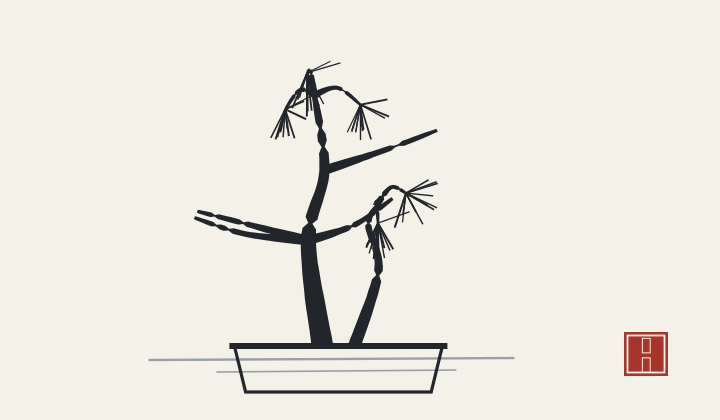
- Sokan — double trunk, one shared base, two distinct lines
- Pot
- Unglazed brown rectangle, 29 x 21 x 8 cm
- Wire gauge
- 3.0 mm on the secondary trunk, 1.5 mm on branches
- Wiring window
- January to February, while the tree is fully bare
- Prune window
- Structural cuts in late winter; shoot thinning in June
- Repot interval
- Every 2 years, just before bud break
- Wintering
- USDA zone 4; needs a genuinely cold winter, will not thrive in mild climates
- Years in training
- 7
Cultivation record
Sokan is failed most often by making two trunks that simply stand next to each other. The design only works when the second trunk is clearly subordinate, and when the two lines move apart and then converge again somewhere in the silhouette.
Finding a subject with a real fork
Japanese larch forks naturally when the leader is damaged, and this tree's fork was already present when it was bought in 2019 as a 5 cm field-grown tree. The fork begins just 3 cm above the root flare, which is what makes it usable: a fork higher up the trunk produces a long shared straight section that looks like a graft. The secondary trunk was the weaker of the two at 2.6 cm against 5 cm and was left unfettered for three seasons to build taper while the main trunk was held back.
The height ratio and the divergence angle
Current heights are 62 cm for the main trunk and 38 cm for the secondary, a ratio of 0.61 which sits in the middle of the useful range. The two trunks diverge at about 28 degrees at the base and the gap between them reaches 14 cm at 20 cm above the soil before narrowing again to 6 cm at canopy level. That narrowing is deliberate: two trunks that run apart forever look like two trees, while two that come back toward each other in the upper third read as one design.
Shaping the secondary trunk with wire, once
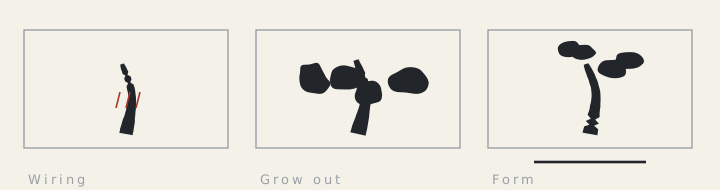
The secondary trunk needed one correction: a 4 cm section where it grew too upright and parallel to the main trunk. In January 2021 a 3.0 mm wire was applied and a gentle S was put into that section, holding it for five months before removal. No further wire has been needed because the divergence above that point is now set by pruning rather than by bending — cutting to outward-facing buds each winter is enough to keep the two lines separating.
Working with a deciduous conifer's schedule
Larch pushes a single strong flush in April and then does very little, so all structural work happens in the six weeks before bud break. Wiring in January or February, while the tree is completely bare, means there is no foliage to hide mistakes and no risk of knocking off needles. Shoot thinning in June reduces each growing tip to two shoots, which keeps the silhouette from thickening. Watering is heavy from April to July, lighter in August, and the tree is allowed to go almost dry before leaf fall in November.
What to remember
- Look for a natural fork within 3 cm of the root flare; higher forks look grafted.
- Keep the secondary trunk at half to two thirds the height of the main trunk.
- Let the trunks diverge to a maximum then converge slightly in the upper third.
- Do all structural work in the six weeks before bud break, while the tree is bare.
Note Growing notes are provided for general information only. Larch needs a cold winter and will decline in mild climates regardless of care.