Tree record 秋 · Autumn
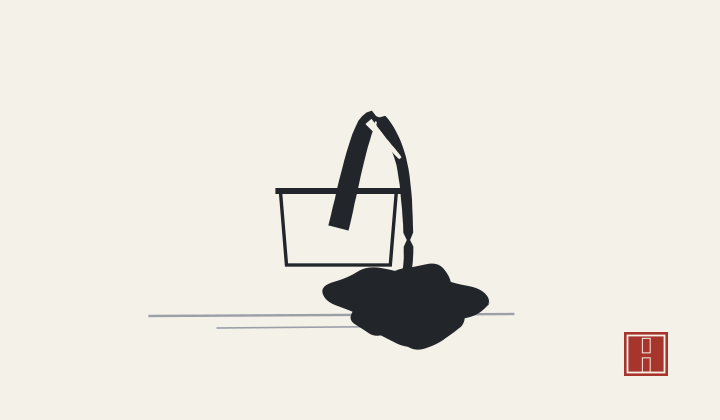
Trident maple in full cascade: growing against gravity
- Style form
- Kengai — full cascade, foliage falls below the base of the pot
- Pot
- Unglazed brown cylinder, 16 cm tall, for a cascade the pot is the anchor
- Wire gauge
- 4.0 mm on the descending trunk, 2.0 mm on cascade branches
- Wiring window
- Late May to June while the wood is supple
- Prune window
- June and August; never cut the underside of the cascade
- Repot interval
- Every 2 years; the tree must be tied into the pot, not just planted
- Wintering
- USDA zone 5b; the pot is above ground so the root ball freezes — mulch heavily
- Years in training
- 8
Cultivation record
Cascade is the one style where the tree grows downward and the pot works upward, and the whole design has to fight the fact that maples want to grow toward the sky. This one took eight years, and the hardest part was not the bending — it was getting the roots to hold the tree in a 16 cm cylinder.
Material and the first decision
The stock came in 2018 as a 3 cm field-grown trident maple with a straight 70 cm trunk. Rather than cut it down to a conventional upright, the whole trunk was laid over in June 2019 and wired into a curve that begins 12 cm above the soil, turns through roughly 150 degrees, and descends 46 cm below the rim of the pot. The initial bend was made in three passes over four days rather than in one movement, because a single hard bend on a 3 cm maple will split the fibres along the outside of the curve.
The bend, in stages
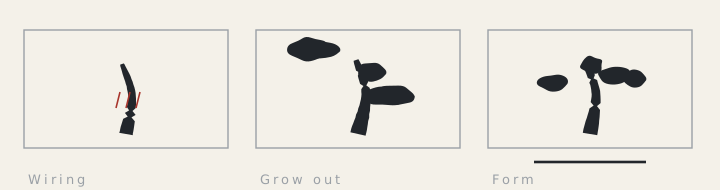
Pass one, 20 degrees. Pass two, two days later, another 60. Pass three, two days after that, the remaining 70. Between passes the tree was kept in shade and misted twice daily. A 4.0 mm aluminium wire was applied before the first pass and re-wrapped between the second and third, spiralling at about 40 degrees with the coil on the outside of the intended curve to resist splitting. Guy wires anchored to the pot rim held the final position for fourteen months. The wire came off in August 2020 and the trunk has held the cascade line unchanged since.
Roots: the part that actually decides whether cascade works
In a 16 cm cylinder, a cascade maple is held up entirely by its roots and its tie-in. The tree is secured with two 4 mm copper wires passed through the drainage holes and over the main root mass, not around the trunk, tightened with a turnbuckle so they can be re-tensioned without repotting. The root ball is built asymmetrically: the heavy roots sit on the side the trunk descends toward, acting as a counterweight. Every repot, roughly every two years in late March, the root mass is combed out and any root thicker than 8 mm growing on the light side is shortened by a third.
Managing apical dominance
The tree does not know it is a cascade. Shoots on the underside of the descending trunk grow weakly, and shoots on the top of that same trunk grow hard and try to become a new leader. From May to September every upward shoot on the descending portion is removed as soon as it reaches three leaves — that is roughly one session every ten days in the growing season, which sounds frequent but keeps the cascade reading as one continuous line. Foliage at the very bottom of the cascade is allowed to grow slightly denser than the rest, because that is where the weight of the design lives.
Watering, feeding and display
A cascade is watered from the top of the pot and the water is allowed to run down the trunk, which keeps the bark clean and discourages the algae that otherwise colonise a permanently damp trunk. In summer this tree takes 1.5 litres a day and the pot is checked twice. Feeding runs from March to September at half strength every two weeks, with a break in the hottest six weeks of summer. For display the pot sits on a stand 40 cm high so the falling foliage is at eye level; on a low bench the design is completely lost.
What to remember
- Bend a 3 cm maple in three passes over four days, not in one movement.
- Tie the tree into the pot with wires over the root mass, tightened with a turnbuckle.
- Remove upward shoots on the descending trunk every ten days through the growing season.
- Display a cascade at eye level or the design disappears.
Note Growing notes are provided for general information only. A cascade can be unstable; check the tie-in wires before every storm season.