Tree record 夏 · Summer
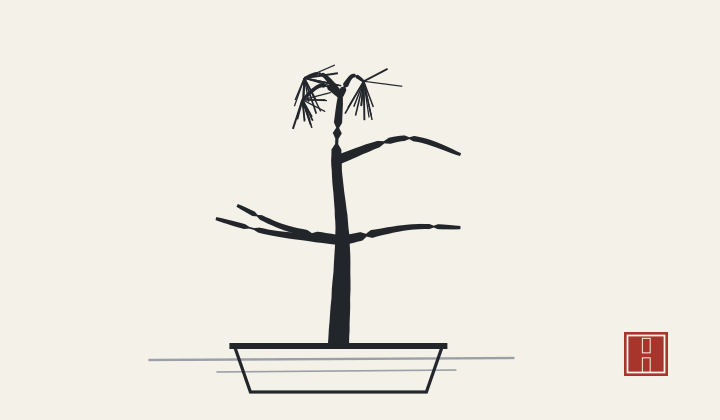
Black pine, chokkan: eleven years to a straight trunk
- Style form
- Chokkan — formal upright, dead-straight trunk, even taper
- Pot
- Unglazed dark clay rectangle, 32 x 24 x 9 cm
- Wire gauge
- 1.0 to 1.5 mm on branchlets only; trunk is unmarked
- Wiring window
- October to November, on lignified shoots
- Prune window
- Candle cutting late June; needle thinning November
- Repot interval
- Every 4 to 5 years, early March before candles extend
- Wintering
- USDA zone 6a; needs full cold, protect roots below -12 C
- Years in training
- 11
Cultivation record
Formal upright is the least forgiving style in bonsai, because every fault in the trunk is on display from the front. This is a record of how the trunk was grown rather than shaped, why no wire ever touched it, and how the needle pads are rebuilt each year from scratch.
Building a straight trunk on purpose
This tree came from a two-year seedling in 2015 and was grown in the ground for six seasons with a 2.4 m bamboo stake tied at three points. The stake was adjusted every March by loosening the ties and re-setting them a little higher, which is the only way to keep the leader truly vertical while the trunk thickens. Side shoots were removed from the lower 40 cm each winter, and the leader was allowed to run unchecked. By autumn 2021 the trunk measured 7 cm at the base and 5.2 cm at the first branch, which is a taper ratio of about 1.35 to 1 over the first third of the height — the number that makes a chokkan read as stable rather than as a pole.
Why no wire on the trunk
A trunk that has been bent and then straightened carries a memory of the bend in the fibre, and on a thick pine it shows up as a slight waver that the eye catches immediately from the front. This one was never wired. The only correction ever needed was in 2022, when the apex leaned 3 degrees to the left; it was fixed by pruning to a bud on the right side and letting the new leader grow for a single season rather than by bending. Training a straight trunk is mostly a discipline of waiting and of choosing buds.
The June candle cut, in numbers
Candles are cut when they have extended but before the needles harden, which here is between 20 and 30 June. On a strong apex the candle is cut back to its base; on the weaker lower branches it is left with 8 to 10 mm of stump. Every candle on the tree is cut within a single three-day window, because the regrowth date determines the final needle length and a spread of even a week produces visibly uneven pads. New buds break in about 18 days. Two buds are kept per cut point, one on each side, and any third is rubbed out in July while it is still soft.
Needle thinning and pad structure
In mid November the old needles are pulled, not cut — grip the sheath between thumb and forefinger and pull downward. Every branch is reduced to the current season's growth plus two or three pairs of last year's needles. The reason for pulling rather than cutting is that a cut sheath leaves a brown stub that stays visible for months, while a pulled needle leaves a clean scar that heals over. This is also the moment when the pads are read properly: stand above the tree and check that each pad has a visible gap of at least two finger widths from its neighbours.
Water and feeding rhythm
Black pine in coarse akadama and pumice is watered once a day from April to October, twice on days above 32 C, and roughly every third day from December to February. Feeding is the part most people get wrong: a high-nitrogen cake from March to May to push the spring flush, then nothing from June to mid September while the second flush hardens, then a low-nitrogen feed through October to build reserves for winter. Feeding through the summer on this species gives long needles and weak buds the following spring.
What to remember
- A straight trunk is grown on a stake and corrected by bud selection, not by bending.
- Aim for a taper ratio near 1.35 to 1 across the lower third of the trunk.
- Cut every candle on the tree inside one three-day window so the pads finish even.
- Pull old needles by hand instead of cutting them, and stop nitrogen from June to mid September.
Note Growing notes are provided for general information only and describe one tree in one climate. Adjust timing to your own growing season and local conditions.