Tree record 春 · Spring
Scots pine on rock: twelve years for roots to take hold
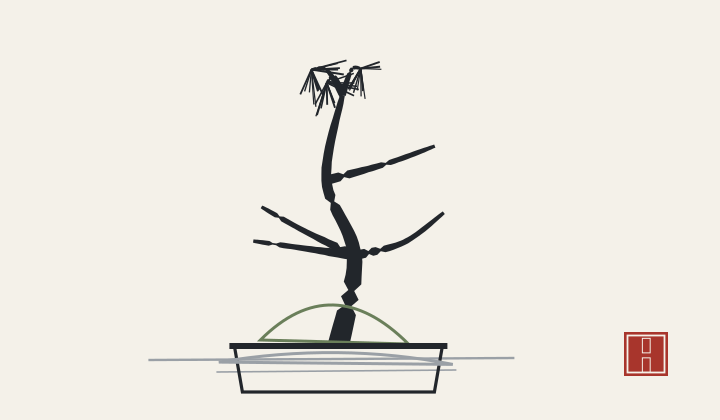
- Style form
- Sekijoju — root over rock, the roots must visibly grip the stone
- Pot
- Shallow unglazed dark oval, 27 x 20 x 6 cm; the rock sits proud of the soil
- Wire gauge
- 1.0 mm on shoots and 2.0 mm on one branch; the rock does the rest
- Wiring window
- October to November on lignified shoots
- Prune window
- Candle cut late June, needle pull November
- Repot interval
- Every 4 years; the rock is never removed
- Wintering
- USDA zone 4; extremely hardy, but the shallow pot freezes solid
- Years in training
- 12
Cultivation record
Root-over-rock is a long bet. For the first five or six years the planting looks like a pine sitting on a stone in a bucket of soil, and there is no way to check whether the roots are actually gripping. This one was checked in year six and again in year eleven.
Choosing and preparing the rock
The stone is a piece of weathered granite about 21 cm long and 13 cm high with two natural fissures running down the north face, roughly 4 mm wide and 5 mm deep. Those fissures are the whole reason it was chosen: roots follow water, and a fissure gives them a path. Before planting, the fissures were cleaned with a wire brush and the whole rock was soaked for 24 hours so it would not draw moisture out of the roots.
The five-year burlap method
In March 2014 the seedling's roots were spread over the rock, guided into both fissures, and the whole assembly was wrapped in burlap and tied with soft twine, then planted 6 cm below the soil surface in a deep training pot. The burlap rots away in about eighteen months but it holds everything in contact through the critical first two seasons. The tree stayed fully buried for five years, being watered and fed normally, with only the canopy worked on above ground. It was lifted in 2019 and the root-rock contact was already firm at four points.
What the second lift showed
The 2025 lift was the first time the rock was fully exposed. Four roots now run visibly down the north face, the thickest at 14 mm, and all four have flattened against the stone rather than remaining round — which is the sign that they have been pressed by contact rather than merely lying alongside. Two roots had crossed each other in the fissure; one was removed, and the cut has since healed over. The rock now stands 2 cm proud of the soil line, which is the minimum for sekijoju to read as root-over-rock rather than as a tree in gravel.
Keeping the canopy subordinate to the stone
A sekijoju pine is read from the soil line upward, so the canopy must not be so heavy that the eye stops there. The canopy is kept to a 24 cm spread and a height of 34 cm on a rock that is 13 cm tall. Two lower branches were removed in 2021 to open the view of the roots, and the remaining branch structure is deliberately asymmetric, leaning away from the fissure side so that the exposed roots get direct morning light for most of the year.
What to remember
- Choose a rock with natural fissures 4 to 5 mm deep; roots follow water, not smooth stone.
- Wrap the roots in burlap and bury the whole assembly for five years without checking.
- A root that has flattened against the stone is gripped; a round root is just resting next to it.
- Stand the rock at least 2 cm proud of the soil or the design will not read.
Note Growing notes are provided for general information only. Lifting a root-over-rock planting early, or exposing it in a single season, frequently kills the tree.