Tree record 秋 · Autumn
Clump-style Japanese maple: five trunks from one root
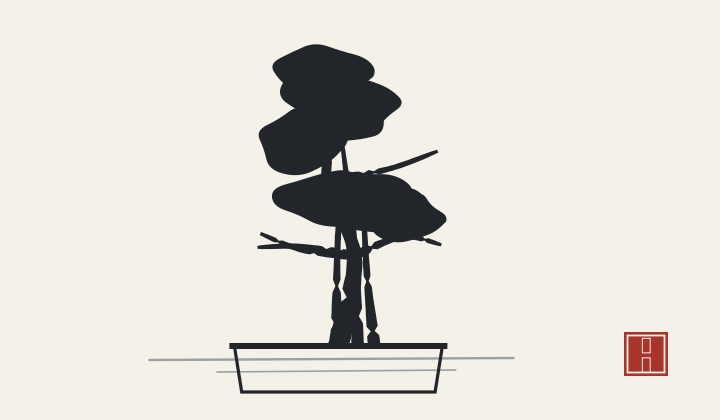
- Style form
- Kabudachi — clump style, five trunks from a single root mass
- Pot
- Unglazed grey-blue oval, 24 x 18 x 7 cm
- Wire gauge
- 1.5 mm on the outer trunks only; the centre is unwired
- Wiring window
- June, on young growth
- Prune window
- Structural thinning in February; pinching June to August
- Repot interval
- Every 2 years, February; the clump is split and re-set every third repot
- Wintering
- USDA zone 5b; frost is needed, wind protection is not optional
- Years in training
- 10
Cultivation record
Kabudachi looks like a forest planting and behaves like a single tree, which is exactly why it is harder than yose-ue. The five trunks share one root mass, so any imbalance in vigour shows up as one trunk quietly taking over the whole clump.
Making the clump, not planting it
This group was built from a single three-year-old seedling. In February 2016 the trunk was cut at 4 cm, and the stump was notched vertically in three places with a grafting knife to encourage shoots to break from below the soil line. Five shoots were kept: the strongest vertical one as the centre, and four others spaced around the stump at roughly 70, 160, 250 and 330 degrees. By 2020 the original stump had been completely swallowed and the five trunks carried their own root systems, though they still share the mass.
Height ratios and the spacing rule
Final heights are 41 cm for the centre trunk and 33, 28, 25 and 22 cm for the outer four. The rule followed throughout was that no two adjacent trunks should differ in height by less than 4 cm, which prevents the clump reading as a flat top. Horizontal spacing at soil level is about 2 to 3 cm between trunks — closer and the base becomes a solid lump that looks grafted. At the widest point the clump spreads 19 cm across a 24 cm pot.
Keeping the trunks from merging
The failure mode of kabudachi is fusion. When two trunks touch, bark forms a callus and within three or four seasons they become one thick trunk with a strange crease. Here the trunks are checked every February and any pair that has grown within 2 mm of each other is separated by inserting a small wedge of plastic, removed once the run of the branch has been reversed by wiring. One pair on the right needed this treatment in 2021 and again in 2023.
Autumn colour as one composition
Japanese maple colour varies with light and with the tree's own reserves, and in a clump a mismatched canopy is immediately obvious. From late August the clump is turned a quarter turn every ten days so all five trunks receive the same sun. No nitrogen is given after 10 August, and potash is increased from late August. If one trunk still colours two weeks ahead of the others, it is fed separately with a light nitrogen solution the following spring to even out its reserves.
What to remember
- Cut the seedling low and notch the stump so shoots break from below soil level.
- Keep adjacent trunks at least 4 cm apart in height and 2 cm apart at the base.
- Insert wedges between trunks that grow within 2 mm of each other, or they will fuse.
- Turn the clump every ten days in autumn so all trunks colour together.
Note Growing notes are provided for general information only. Your local autumn temperatures will shift the colouring window by two to four weeks in either direction.