Tree record 夏 · Summer
Dwarf pomegranate, neagari: exposing roots 8 mm at a time

- Style form
- Neagari — exposed root, the root mass is the lower third of the design
- Pot
- Shallow unglazed sand-coloured round, 23 x 6 cm
- Wire gauge
- 1.5 mm on the upper branches only; roots are shaped by burial, never by wire
- Wiring window
- May to June on green shoots
- Prune window
- April, cutting back to two nodes to force flowering shoots
- Repot interval
- Every 2 years; each repot exposes another 8 to 10 mm of root
- Wintering
- USDA zone 8a; indoors above 5 C in cold climates
- Years in training
- 8
Cultivation record
Exposed-root style cannot be rushed, because the roots have to thicken while they are still underground and then be revealed gradually enough that they harden off. This pomegranate has had eight repots and 7 cm of root brought into the light.
Growing a root system worth showing
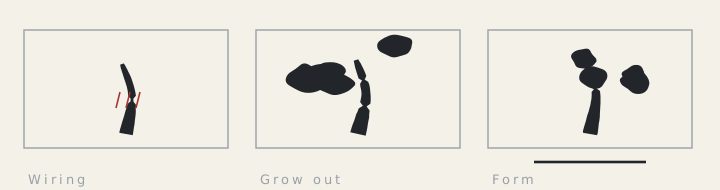
The tree came from a cutting struck in 2018 and was planted over a flat stone 4 cm below the soil surface, with the roots spread radially and held in place by two crossed wires under the stone. It stayed buried for four seasons, being lifted 1 cm each February. The stone forces the roots to run horizontally and then turn down, which produces the outward flare that makes neagari convincing. Root diameter at the base reached 12 mm before any of it was visible.
The 8 mm rule and how exposure is done
Each February the root mass is brushed free of the top 8 to 10 mm of soil and the newly exposed section is left to dry in shade for three days before the tree goes back into full light. In the first two weeks after exposure the new roots are watered less often than the rest of the pot — about every third day — because wet new root bark softens and splits. Eight repots at roughly this rate have brought 70 mm of root above the soil line, and the exposed portion now accounts for about a third of the total height of 26 cm.
Subduing the top to match the bottom
Neagari only works when the canopy is light enough not to overpower the roots. Here the canopy is kept to a spread of 16 cm and just three primary branches, all wired downward in May 2022 to suggest weight falling onto the root mass. The trunk above the roots is only 9 cm tall, because anything taller makes the exposed roots look incidental rather than structural.
Flowering and fruit on a light canopy
Dwarf pomegranate flowers from June on shoots produced the same season, so the tree is pruned hard in April to two nodes on every previous year's shoot. Roughly 20 flowers appear; the orange-red single form is left to set about six fruit, which are thinned to three so the canopy is not dragged down. Watering through the fruiting period is once daily and never overhead, since water sitting in the flower cups causes rot. The tree is fed low-nitrogen from May onward so that growth does not outrun the flowers.
What to remember
- Plant over a flat stone and lift the tree 1 cm each year for four years to build a horizontal flare.
- Expose no more than 8 to 10 mm of root per repotting, and dry the new root bark in shade for three days.
- Keep the canopy under about 16 cm spread or it will overpower the roots.
- Prune hard in April; pomegranate flowers on the current season's growth.
Note Growing notes are provided for general information only. Exposed roots are vulnerable to frost and to drying wind, so adjust winter protection to your own minimum temperatures.