Seasonal note 夏 · Summer
Mangzhong: the wire check that saves branches
- Solar term
- Mangzhong, around 6 June
- Main task
- Full wire check on every tree in the collection
- Watch out for
- Wire bite, which happens within three weeks of growth starting
- Do not do
- Re-wire on the same line if a bite has already formed
- Check interval
- Every ten days from bud break to the end of July
Cultivation record
Every spring a certain number of branches are lost the same way: wire applied in winter, growth starts in April, and by the beginning of June the wire has disappeared into the bark. The check is ten minutes per tree and prevents almost all of it.
Why June is the danger month
Winter-applied wire sits on dormant wood through February and March with no problem, because the branch is not thickening. Once growth starts in April, the branch begins to put on girth, and the rate accelerates through May. By early June a branch that has grown 2 mm in diameter is pressing 1 mm into each side of a wire that was correctly sized in January. On fast-growing species such as elm and trident maple, that can happen in three weeks.
How to do the check properly
Take each tree in turn and run a fingertip along the whole length of every wire, on all four sides of the branch. Anywhere the finger catches, or where the wire feels recessed rather than proud, is a bite. Check the underside first: bark is thinner there and damage shows earlier. On a 60-tree collection this takes about two hours. The check is done every ten days from bud break to the end of July, and records are kept of which trees needed wire removed, because those trees are the ones to check first the following year.
What to do when you find a bite
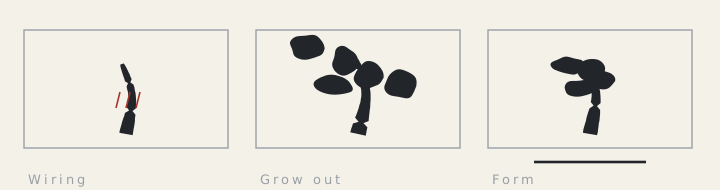
Remove the wire immediately, that day. If the branch has not set, it will spring back, and the temptation is to re-wire it at once — but re-wiring on the same line presses into the same damaged cambium and turns a groove into a cut. The correct response is to wait three to four weeks for the bite to callus over, then re-wire with a heavier gauge on a slightly different line, so the pressure falls on undamaged bark. On maples a bite that is 1 mm deep will still be faintly visible after five years.
Reducing the risk in the first place
Three habits cut bite losses substantially. First, use slightly heavier wire than the minimum, because a heavier wire can be applied with fewer turns and lower pressure per unit area. Second, wire in late winter rather than mid winter, so the wire has less time before growth begins. Third, on fast species, plan to remove the wire in June rather than leaving it through the season, and accept that a branch that sets in four months has set well enough for a first styling.
What to remember
- Run a fingertip along every wire; check the underside first, where bark is thinner.
- Check every ten days from bud break to the end of July, and keep a record of problem trees.
- Remove a biting wire the same day and wait three weeks before re-wiring on a different line.
- Use slightly heavier wire with fewer turns, and plan to remove it in June on fast species.
Note Calendar terms describe a traditional seasonal marker, not a local weather forecast. Always judge timing by what your own trees are doing.