Seasonal note 春 · Spring
Guyu: full feeding begins, and the season's first hard shoot selection

- Solar term
- Guyu, around 20 April
- Main task
- Move to full-strength feeding; first major shoot selection of the season
- Watch out for
- Long wet spells, which rot the new root tips repotted trees have just made
- Do not do
- Give high-nitrogen feed to flowering or fruiting species from this point
- Feed strength
- Full strength every two weeks for deciduous trees in development
Cultivation record
Guyu is when the growing season stops being fragile. Roots are working, the first flush has hardened, and the tree can take a full feed. It is also the moment when the season's shoot selection has to be made, because by May the shoots will have hardened and the choice will be harder.
Moving to full strength safely
The progression from no feed to full strength should take about four weeks: quarter strength for two weeks after the first leaves darken, then half strength for two weeks, then full strength. Applying full strength to a tree that has never been fed that season risks burning the new root tips, which shows as brown, shrivelled tips on otherwise healthy white roots. Slow-release cakes or pellets can be placed on the soil surface at this point instead of liquid feed; two cakes on a 20 cm pot, replaced every six weeks, is a reasonable rate for a deciduous tree in development.
The shoot selection that pays for itself
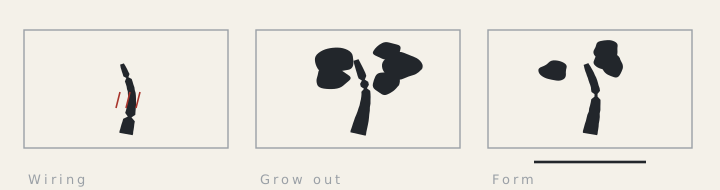
By mid April each branch has usually produced five to ten shoots where two or three are wanted. Selection is done by hand: keep the shoots that point outward, are evenly spaced along the branch, and are strongest; remove the ones growing straight up and straight down, the ones in the crotch, and any that are crowded against a neighbour. Leaving twice as many shoots as needed and thinning later costs the tree resources it has already spent, and produces coarse growth in the interior that has to be removed anyway.
The wet-weather problem
Weeks of steady rain in this period are more dangerous than a dry spell, because the top of the pot looks wet while the bottom is waterlogged and airless. New root tips produced by a repot cannot survive more than about three days without oxygen. In a wet spell, pots are moved under cover or tilted onto a block so that water drains from one corner rather than pooling. Trees that are not repotted and are in free-draining mix are much less at risk and can be left out.
Adjusting feed by purpose, not by species
From Guyu the feed changes according to what the tree is being grown for rather than what it is. Trees in trunk development get a high-nitrogen feed — roughly twice the nitrogen of a balanced feed — to push extension. Trees in refinement get a balanced feed at half strength, more often, because the goal is fine growth rather than long growth. Flowering and fruiting species switch to low nitrogen immediately, since nitrogen applied from here produces shoots that displace flower spurs.
What to remember
- Ramp to full strength over four weeks; full strength on an unfed tree burns new root tips.
- Do shoot selection by hand in mid April, keeping outward, evenly spaced, strong shoots.
- In a wet spell, tilt or move pots; new root tips die after about three days without oxygen.
- Match feed to purpose: high nitrogen for trunk development, low nitrogen for flowers and fruit.
Note Calendar terms describe a traditional seasonal marker, not a local weather forecast. Always judge timing by what your own trees are doing.