Seasonal note 春 · Spring
Qingming: the repotting deadline, and what happens if you miss it
- Solar term
- Qingming, around 5 April
- Main task
- Finish deciduous repotting; first wiring of the season on new shoots
- Watch out for
- Late frost on open leaves, and root damage from repotting too late
- Do not do
- Repot a tree that is fully in leaf unless there is no alternative
- Feed from
- Half strength once the first flush has hardened
Cultivation record
By Qingming most temperate deciduous trees are in leaf and the repotting window has closed. Trees repotted after this point do not die immediately — they stall, and the stall costs a season that you notice the following year.
Why the deadline is real
A tree repotted at bud swell has no leaves, so its water demand is near zero while the roots knit into new soil. Six weeks later the same tree is carrying a full canopy and transpiring at full rate, and the root system has just lost a quarter to a third of its mass. The tree cannot supply the leaves, so it sheds some, stops extending, and spends the next two months rebuilding. It usually does not die; it simply loses a season, and on a tree in refinement that is the expensive part.
What to do if you are late
There are two sensible choices. The first is to wait a full year and repot the following spring — often the better option on a healthy tree, since one extra year in the pot rarely does harm. The second is to repot anyway but change the method: remove only about a fifth of the root mass instead of a third, keep the root ball intact on one side, and place the tree in bright shade for two full weeks with daily misting. Do not do a heavy root prune and full defoliation in the same season under any circumstances.
The first wiring of the season
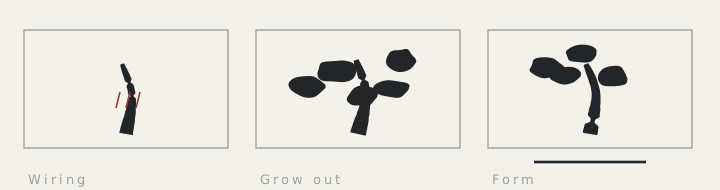
New shoots on deciduous trees are at their most flexible in the four weeks after they harden, which on most maples is roughly from mid April to mid May. This is the window for guiding young shoots into the shape they will hold, and it takes very little force: a 1.5 mm wire on a 4 mm shoot will hold it perfectly. Wiring shoots at this stage is far more effective than cutting them back, because the wood is still growing and will set in the position you give it within a season.
Late frost, and the cost of one bad night
Open leaves on a maple or an elm are damaged at about -2 C, and a single frosty night after a warm day can blacken an entire canopy. The damage is not fatal, but the tree has to push a second set of leaves from stored reserves, which costs it the equivalent of about four weeks of growth. Where frost is forecast, trees in pots are best moved into a shed or against a south-facing wall; a sheet of horticultural fleece laid over the canopy overnight is enough for a short, light frost.
What to remember
- Finish deciduous repotting by the time the tree is in full leaf; the stall costs a full season.
- If repotting late, remove only a fifth of the roots and shade the tree for two weeks.
- Wire young shoots in the four weeks after they harden; they set in one season.
- Move trees under cover if frost is forecast; -2 C blackens open maple leaves.
Note Calendar terms describe a traditional seasonal marker, not a local weather forecast. Always judge timing by what your own trees are doing.