Technique paper 冬 · Winter
Structural wiring in late winter: eight steps and the six mistakes to avoid

- Season
- Late winter, January to early March, on bare deciduous trees
- Risk level
- Medium — split branches and wire bite are both common
- Steps
- 8
- Working temperature
- Above 5 C; frozen wood splits rather than bends
- Wire-on time
- 4 to 6 months on deciduous, checked every 10 days
Cultivation record
Tools
- Anodised aluminium wire, 1.0 to 4.0 mm
- Wire cutters with a flush face
- Jin pliers or branch benders
- Rubber or leather padding strip
- Camera and a plain background cloth
Risk level:Medium risk · 8 steps
Late winter is the only window when a deciduous tree shows you its whole skeleton and the wood still has enough give to be moved. It is also the window in which most wiring damage happens, because the tree is stiff from cold and there is no foliage to hide the result.
Why late winter and not any other time
On a bare deciduous tree you can see the whole branch structure, judge the spacing between branches and follow a line from the nebari to the apex without leaves in the way. The wood is also at its most flexible relative to its stiffness in mid summer, because growth is still dormant and the sap is down. The window runs from about 15 January to 10 March in temperate zones; earlier than that the wood is frozen and splits, later than that the buds are moving and a bend will dislodge them.
Choosing the gauge with a simple rule
Wire should be roughly one third the diameter of the part it is holding. A 9 mm branch takes 3.0 mm wire; a 3 mm twig takes 1.0 mm. The test is behavioural rather than arithmetic: bend the branch gently with the wire in place and watch the wire itself. If the wire deforms, it is too thin and the branch will spring back within two weeks. If the wire holds its shape easily, it is right or slightly heavy, and slightly heavy is the safer error on a structural bend.
The six mistakes that account for most damage
One: wiring parallel to the branch rather than at 45 degrees, so the wire does nothing. Two: no anchor, so the coil slides and strips bark. Three: bending with the fingers on the inside of the curve instead of the thumbs, which kinks the branch. Four: bending in one movement instead of increments, which splits the wood. Five: leaving the wire on through the growing season untended, which bites in about three weeks once growth starts. Six: wiring a branch that is too old and hard — anything over about 15 mm on most species is better shaped by cutting back and regrowing.
Aftercare and when to remove the wire
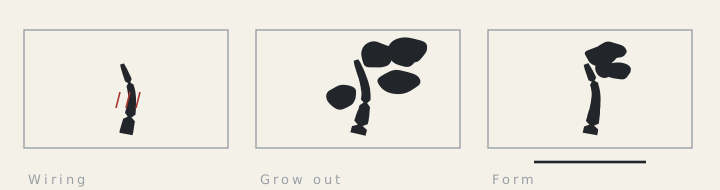
The tree goes back into its normal position the same day, but out of direct sun for the first week. Wire is checked every ten days by running a finger along it: any point where the wire has begun to sit in a groove is removed that day, and if the branch has not set, it is re-wired with a heavier gauge on a different line so the bite does not repeat in the same place. On most deciduous species four to six months is enough for a set; on maples it can be as little as ten weeks, and on oaks it can take a full year.
Steps in order
- Photograph the tree from four sides against a plain cloth and decide the front. Do not proceed until you have written down which side it is.
- Remove the tree from its pot if you plan to wire the base of the trunk; wiring through a rim is possible but limits access.
- Choose a wire roughly one third the thickness of the section it holds. When in doubt go one gauge heavier, not lighter.
- Anchor the wire: bury the first 3 cm in the soil, or hook it around the nebari, so the coil cannot slide.
- Coil from the base upward at about 45 degrees, keeping the pitch at roughly 1.5 times the branch diameter.
- Bend with both thumbs on the inside of the curve and the fingers spread on the outside, working in small increments of 10 to 15 degrees.
- Work thickest to thinnest, and each time finish a bend, re-check that the wire is still seated against the bark.
- Photograph the finished result from the front and compare it with the first photograph; correct anything that reads wrong before the wire sets.
What to remember
- Wire at 45 degrees, one third the thickness of the part, anchored at the first turn.
- Bend in increments of 10 to 15 degrees with thumbs on the inside of the curve.
- Check the wire every ten days; re-wire on a different line if it bites before the branch sets.
- Do not wire wood thicker than about 15 mm; cut back and regrow instead.
Note Growing notes are provided for general information only. Wiring a tree too tightly, or leaving wire on through a growing season, commonly kills branches permanently.