Technique paper 春 · Spring
Repotting and root pruning: the day the tree either speeds up or stalls
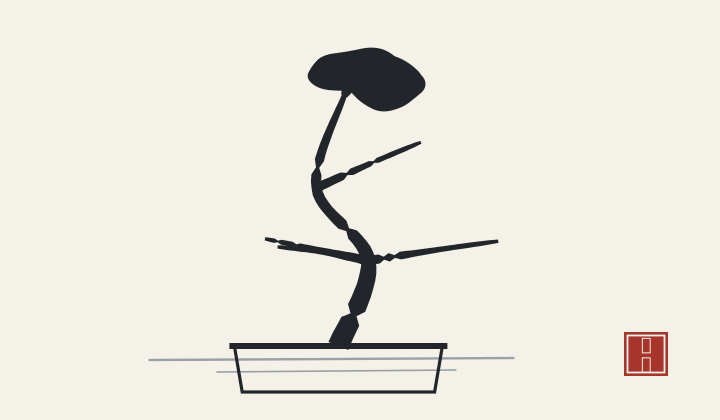
- Season
- Spring, at bud swell, before the first leaf opens
- Risk level
- High — root work done at the wrong moment kills trees outright
- Steps
- 9
- Root removed
- One quarter to one third of the mass on a healthy deciduous tree
- Water after
- Soak once, then nothing for 4 days, then normal
Cultivation record
Tools
- Root hook and a wooden chopstick
- Concave cutters and root shears
- Sieve with 4 mm and 8 mm mesh
- Fresh akadama, pumice and charcoal
- Aluminium or copper tie-down wire
Risk level:High risk · 9 steps
Root work is the single highest-leverage operation in bonsai and the one with the least margin for error. Done at bud swell on a healthy tree it produces a season of strong growth; done three weeks later it produces a tree that sulks until August.
Reading the moment: bud swell, not bud break
The right day is when the buds have visibly swollen and changed from dark brown to a lighter, waxy green-brown, but before any leaf has unfurled. On a trident maple in a temperate climate this is usually a ten-day window in the second half of March. Earlier and the tree has not begun to mobilise its reserves, so recovery is slow; later, once leaves are open, the root loss and the transpiration demand hit at the same time and the tree stalls for months.
What to take off and what to leave
The target is to remove a quarter to a third of the root mass on a healthy deciduous tree. Priority for removal: any root circling the bottom of the pot, any root thicker than 8 mm growing straight down, and any crossing root that has begun to graft itself onto a neighbour. Leave the fine feeder roots on the outer perimeter wherever possible — these are the roots that will do the work this season. On a trident maple of 25 cm trunk base, a typical repot removes about 40 cm of coarse root and leaves several hundred grams of fine root.
Soil grades, and why two sieves matter
Soil is sieved into a coarse grade, roughly 6 to 8 mm, and a fine grade, roughly 3 to 4 mm. The coarse grade goes in first, mounded over the drainage holes to about a third of the pot depth, because that is where water needs to move freely. The fine grade goes around the roots, where the smaller particles hold moisture in contact with the feeder roots. Mixing the two and using one grade throughout is the single most common reason a repotted tree does not grow well: either the drainage is too slow or the roots have no moisture contact.
The first four days decide the season
Water once, thoroughly, until it runs clear, and then leave the tree alone for four days. The instinct to keep watering a freshly repotted tree is what causes most post-repot losses: wounded roots in constantly wet soil rot rather than heal. After four days, normal watering resumes, and the tree stays in light shade for a week before returning to full sun. No fertiliser for four weeks, then half strength.
Steps in order
- Stop watering three days before the operation so the root ball holds together when it comes out.
- Run a knife around the inside of the pot rim, then lift the tree by the trunk base with one hand under the root ball.
- Comb out the outer third of the root ball with a root hook, working from the outside inward and downward.
- Remove any root thicker than 8 mm growing straight down or circling the pot; cut these with a saw, not shears.
- Shorten the remaining roots by a quarter to a third, cutting on a slant so the cut face points downward.
- Comb out and clean the base of the trunk until the nebari is visible as a set of radiating roots.
- Sieve fresh soil into two grades and place the coarser grade around the drainage holes and the finer grade around the roots.
- Tie the tree into the pot with two wires over the root mass, not around the trunk, and tighten until the tree cannot be rocked.
- Water once until it runs clear from the drainage holes, then place the tree in shade for a week and do not water again for four days.
What to remember
- Repot at bud swell, before any leaf opens; the window is about ten days.
- Remove a quarter to a third of the root mass on a healthy deciduous tree.
- Sieve into coarse and fine grades: coarse at the bottom, fine around the roots.
- Water once, then nothing for four days; wet wounded roots rot instead of healing.
Note Growing notes are provided for general information only. Root pruning at the wrong time, or removing too much root, kills trees; if in doubt remove less.