Technique paper 夏 · Summer
Candle pruning two-needle pines: cutting the whole tree in one three-day window
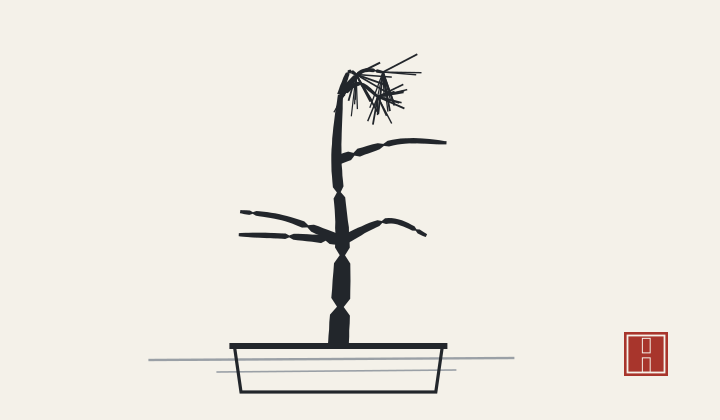
- Season
- Late June to early July, when candles have extended but needles have not hardened
- Risk level
- Medium — a mistimed cut costs a whole season of refinement
- Steps
- 6
- Do not cut
- Weak trees, trees repotted the same spring, or trees that lost needles to disease
- Result timing
- New buds break in about 18 days; needle length is set by early November
Cultivation record
Tools
- Thumb and forefinger, or a sharp pair of pine scissors
- Tweezers for removing buds
- A note pad for recording the cut date
Risk level:Medium risk · 6 steps
Candle cutting is how a pine stops being a young tree and starts being a refined one. The technique takes ten minutes to learn; the timing and the follow-up take five years to get right, and the most common failure is not cutting badly but cutting across too many days.
What a candle actually is, and why it gets cut
In spring a two-needle pine extends a single shoot — the candle — which carries the season's needles. Left alone, that shoot will extend 15 to 25 cm on a strong tree and produce needles 8 to 12 cm long, which is far too coarse for a bonsai silhouette. Cutting the candle in late June removes the dominant shoot and forces the tree to break two or more smaller buds from the cut point, each producing a shorter shoot with shorter needles. Repeated over years, this is what turns a coarse branch into a fine pad.
Why the whole tree goes in three days
The length of the needles produced by the second flush is a function of how much growing season is left when the new buds break. Buds that break on 25 June have about 100 days and produce 6 to 7 cm needles; buds that break on 10 July have about 85 days and produce 4 to 5 cm needles. That is the whole reason for cutting early rather than late. It is also why the cut has to be done across the same window: if one branch breaks on 25 June and another on 2 July, by November one pad is 2 cm taller than the other and the silhouette is visibly uneven.
The strength gradient: strong cut hard, weak cut soft
A pine pushes its strongest growth at the apex and on the upper branches, and the weakest on the lowest branches. If every candle is cut the same way, the apex regrows harder than ever and the lower branches fall further behind. The correction is to cut by position: candles at the apex and top cut back to the base, removing all of the season's extension; candles in the middle left with 5 mm of stump; candles on the lowest, weakest branches left with 10 mm of stump so they keep more needle area and can catch up. On this tree the difference between the strongest and weakest cut is about 12 mm of retained candle.
The eighteenth day: bud selection
New buds appear about 18 days after cutting, usually two or three at each cut point and occasionally five. Left alone they produce a cluster of shoots that will thicken the branch and produce a mass of weak growth in the interior. Two buds are kept at each point, one on each side of the branch and both facing slightly outward and upward, and the rest are rubbed out with tweezers while they are still the size of a pinhead. Waiting two weeks to do this makes the job four times harder, because the buds have already begun to harden into woody shoots.
Steps in order
- Wait until the candles have extended to 4 to 6 cm and the needles inside them are visible but still soft and pale.
- Cut the strongest candles — usually the apex and the upper branches — back to their base, leaving no stump at all.
- Cut the medium candles back to about 5 mm of stump, and the weakest, on the lower branches, to about 10 mm.
- Do the whole tree in one session, in the same three-day window, so that every bud breaks on the same date.
- Return in about 18 days and rub out surplus buds with tweezers, keeping two per cut point, one on each side.
- In November, pull the old needles by hand and check the result: even pad heights mean the timing was right.
What to remember
- Cut candles at 4 to 6 cm, before the needles harden, in a single three-day window.
- Cut strong candles to the base, medium to 5 mm, weak lower candles to 10 mm of stump.
- Keep exactly two buds per cut point, one on each side, and rub the rest out at pinhead size.
- Do not candle-cut a weak or newly repotted pine; the technique is for trees already growing strongly.
Note Growing notes are provided for general information only. Candle timing depends entirely on local day length and temperature; the dates given are for a temperate northern-hemisphere climate.