Tree record 春 · Spring
Collected juniper: restoring a 90-year-old trunk without killing it

- Style form
- Bunjin — literati, built from a collected trunk with existing deadwood
- Pot
- Deep unglazed training pot for the first five years, then a shallow oval 24 x 7 cm
- Wire gauge
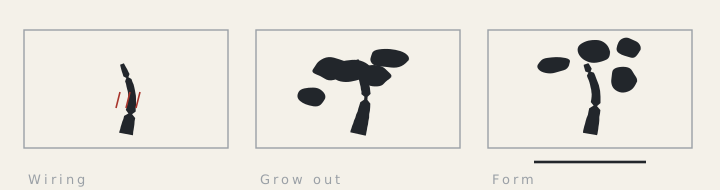
- Only 1.0 mm on foliage; the trunk is shaped by pruning alone
- Wiring window
- October to November, on settled foliage
- Prune window
- April and September only; nothing in the six weeks after collection
- Repot interval
- First repot three years after collection; every 4 years after that
- Wintering
- USDA zone 6b; protect from wind for the first three winters
- Years in training
- 5 since collection; trunk age estimated at 90 years
Cultivation record
Yamadori material is mostly a test of restraint. This trunk was collected in 2021 with a 12 cm base, existing deadwood and a single surviving branch of foliage. Five seasons later it has three foliage masses and an intact live vein. Almost everything that was done in that time was waiting.
Collection and the first two years
The tree was lifted from a granite outcrop in spring 2021 with a root ball about 30 cm across, most of it fine feeder roots held in decomposed granite. It was planted straight into a deep training pot in the same mix it came out of — 70 percent of the original soil plus 30 percent coarse pumice — and kept in a shaded, wind-free frame for the first year. No pruning of any kind was done in 2021 or 2022. Watering was once daily, twice on hot days, and the tree was fed only from August of the second year.
Reading which veins survived
In the spring of 2023, bark was scraped very lightly with a thumbnail at eight points around the base. Four were green underneath, four were dry brown. The four live points clustered on the south and east faces, which is typical for collected material that grew with one side exposed. The whole styling plan was built around that: the dead half faces the viewer and carries the shari, the live half faces away and stays in shade, and the pot is oriented so that the live side receives the morning sun.
Styling with pruning only
The single surviving branch was 60 cm long and completely straight. Rather than wire it into a shape, it was cut back in April 2024 to a side shoot at 34 cm that already pointed slightly back toward the trunk. Subsequent growth has been directed entirely by cutting to inward- and upward-facing shoots, which on this species produces the irregular, angular movement that bunjin needs. In five seasons the crown has been built into three masses, each about the size of an open palm, at 40, 55 and 72 cm on a trunk that finishes at 88 cm.
The deadwood it came with
The trunk's existing deadwood runs 52 cm up the north face and had been weathering in the open for decades before collection. It was left completely untouched for two years and then cleaned in 2023 with a stiff nylon brush only — no carving tools, no lime sulphur in the first treatment. A 15 percent lime sulphur application was made in February 2024 and repeated in February 2026. The wood underneath the bleached surface is hard and grey, and the aim is to keep it that way rather than to make it white.
What to remember
- Do not style a collected juniper for the first two years; feed only from August of the second year.
- Scrape-test eight points around the base to find which veins survived before planning anything.
- Build a bunjin crown by cutting to inward-facing shoots rather than by wiring.
- Clean collected deadwood with a nylon brush first; save the lime sulphur for year three.
Note Growing notes are provided for general information only. Collecting plants from the wild requires landowner permission and may be restricted by local law.