Tree record 春 · Spring
Flowering quince: straight trunk, flowers on old wood

- Style form
- Chokkan — formal upright, but chosen because the base was already straight
- Pot
- Unglazed green-grey rectangle, 22 x 16 x 7 cm
- Wire gauge
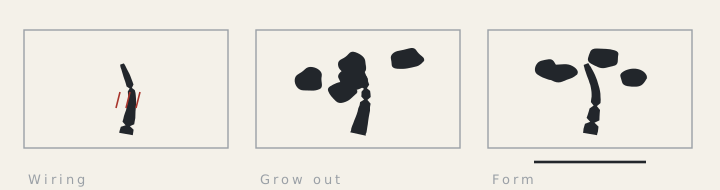
- 1.5 mm on the single retained branch; quince bark marks badly
- Wiring window
- May, after flowering, and for no more than ten weeks
- Prune window
- Immediately after flowering, cutting to two buds
- Repot interval
- Every 3 years, in September rather than spring
- Wintering
- USDA zone 5; needs cold to flower well, protect the roots below -10 C
- Years in training
- 6
Cultivation record
Quince is grown in bonsai for six weeks of flower in March and for the fruit that follows, and almost every mistake made on it comes from pruning at the wrong time. This tree is a straight-trunked subject that was left straight on purpose.
A straight trunk is a reason to leave it straight
Most quince material has a crooked, shrubby base and gets pushed toward slanting or clump styles as a result. This one came from a cutting taken in 2020 that grew a genuinely straight 2.2 cm trunk with a good flare, so formal upright was the obvious choice rather than a forced one. The single retained branch was kept low at 9 cm to give the trunk something to work against, and the canopy above is deliberately narrow — 16 cm spread on a 34 cm tree — so the trunk is never hidden.
Pruning after flowering, to the day
The flowers open in the second week of March and drop about ten days later. Pruning starts as the last petals fall, in the last week of March. Every shoot that flowered is cut back to two buds, and shoots that did not flower are cut back to three or four to build structure. Doing this in April rather than in autumn is the whole difference: the cut wood then has the entire season to ripen the two buds that will carry next year's flower. A quince pruned in November will flower, but only on whatever wood it happens to have left, which is usually the tips.
Suckers, and how to remove them
This species produces stoloniferous shoots from the root mass from April onward, and on a straight-trunked tree they ruin the base within two seasons. They are removed by gripping the shoot at the base and pulling sharply downward while it is still soft, in late May or early June. This tears the dormant bud that produced it out of the root with it. Cutting the shoot flush with secateurs leaves the bud intact and it will produce two shoots next year, so pulling is not a preference, it is the only method that reduces the count.
September repotting and the fruit
Root work is done in the first half of September, when the tree is still in leaf but the summer flush has finished. The root mass is reduced by about a quarter and replanted in 60 percent akadama, 30 percent pumice and 10 percent leaf mould. Quince sets heavy crops of small yellow fruit, which is left on this tree only in small numbers — four or five at most — because a heavy crop takes so much out of the tree that flowering the following spring is noticeably weaker.
What to remember
- Prune immediately after flowering, never in autumn, or you cut away next year's flower buds.
- Pull basal suckers downward by hand; cutting them leaves the bud and doubles them.
- Repot in September, when quince recovers faster than from spring root work.
- Leave no more than four or five fruit or the following spring's flowering is reduced.
Note Growing notes are provided for general information only. Chaenomeles fruit is not edible raw; do not present it as a food crop without checking local guidance.